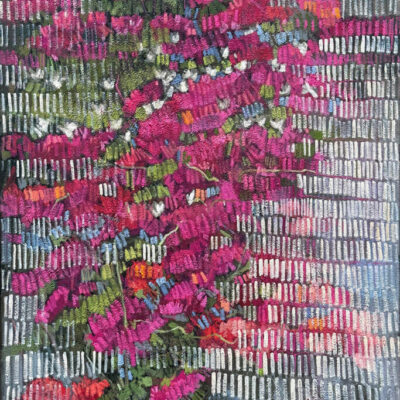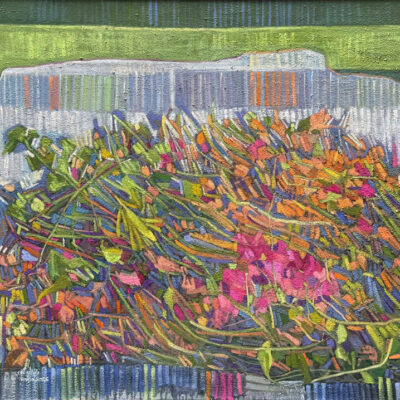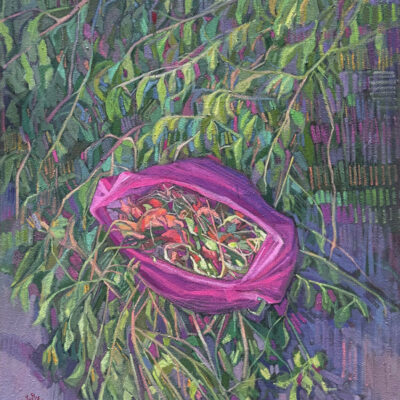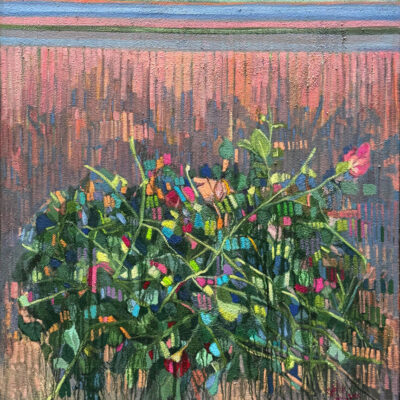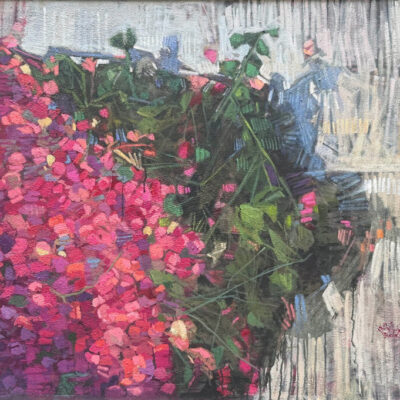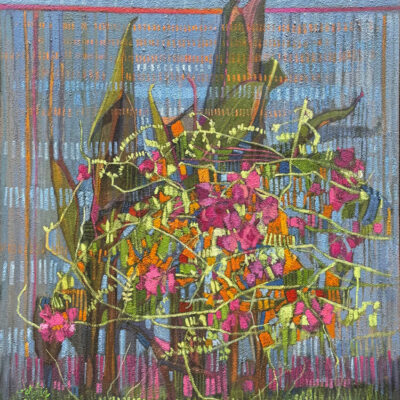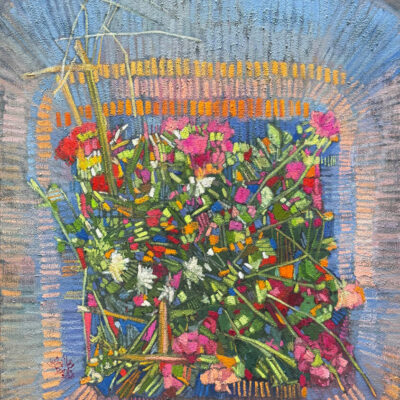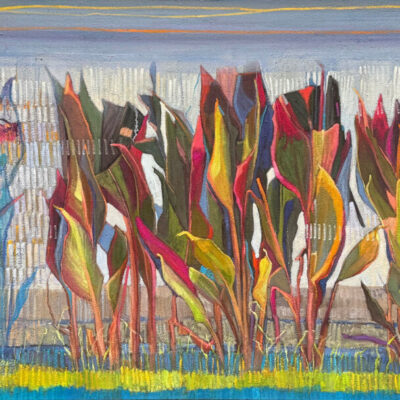
There is a kind of life that does not appear at the moment of fullness, but after it. When the shine softens a little, when time passes through things, when the hand leaves its trace, and when silence proves more enduring than noise itself. It is from this terrain that Rania Abu Elazm’s works unfold, not as images grasped at first glance, but as charged fields of accumulated feeling, layers of existence shaped by transformation and marked by traces that do not easily disappear.
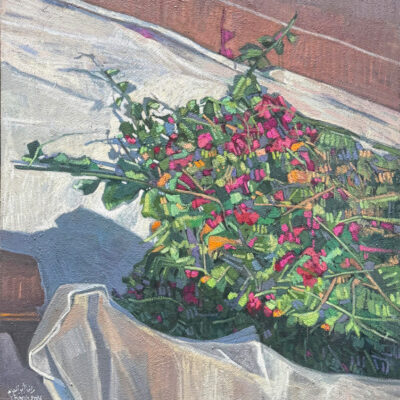
In these paintings, the botanical elements never seem still, even at their quietest. A hidden pulse runs through the mass, through the color, through the composition itself. Something recedes while something else begins to form; something fades while something else intensifies. Life here does not settle into a single form of appearance. It keeps moving from one state to another, from one time to another, always retaining a deeper inner warmth.
What draws attention is not the scene alone, but its condition. Delicacy is never separate from fatigue, beauty never detached from the mark of time, and color does not arrive as ornament so much as memory. Each work carries within it a sense of passage, not only the movement of things through space, but their passage through time as well: from fullness to dimming, from presence to trace, from a visible instant to another life, more concealed and more profound.
The works move through a suspended zone between imagination and reality, between what is sensed and what is imagined, between memory and what remains of it on the surface.
For this reason, the paintings do not reveal themselves all at once. They come forward slowly, allowing the gaze to settle, only to uncover that what seems calm holds its own tension, and what appears silent is simply another form of density. There is always something on the verge of vanishing and something else on the verge of beginning. Between the two, the image holds itself in a rare and unsettled balance, deeply human in its fragility.
This atmosphere becomes even more concentrated in the way the surface itself is built. Rhythms, repetitions, and faint visual marks give the painting an extended temporality, opening around its elements a field of resonance, as though each form were not content with its own presence alone, but also left behind its vibration. In this way, the painting preserves not only the figure, but its tremor. It does not present a closed image, but a living, open trace—one that allows the eye to see and feeling to become implicated.
Within this world, fragility begins to feel like an inner memory of things. Not fragility as weakness, but as the capacity for transformation, and the ability to carry what has passed through without letting it fully disappear. The fragility of a leaf as its color shifts, the fragility of a branch as it bends, the fragility of a being moving from one state into another, carrying within it both what was lost and what survived. This is where the intimacy of these works lies, and why they feel so near: they touch something we all know, even if we have never named it.
What emerges here is not simply a poetics of delicacy, but something closer to a parallel life. A life that begins when the first image begins to loosen. A life that continues beneath the visible one, beside it, within it. Through this refined sensitivity to change, Rania Abu Elazm opens a rare contemplative space in which the image becomes a site of passage, and silence becomes the bearer of all that language fails to hold.
Veiled Tremble XI