Psycho Maps and Metaphysical Bodies Souad Abdelrasoul’s project “Psycho Maps and Metaphysical Bodies” presents a series of paintings that explore the intersections of body, mind, myth, and memory through a unique metaphysical perspective. Souad is considered one of Egypt’s most prominent female artists, using a personal visual language that breaks the rules of traditional representation by analyzing and deconstructing the female body into metaphorical “psychological maps,” concealed surfaces, and chambers. Her women, both fragile and resilient at the same time, appear in surreal atmospheres where primitivism meets metaphysics.
The Exposed Body and the Failure of Protection In Souad Abdelrasoul’s world, the presence of woman cannot be reduced to the conventional notion of “nudity.” The body in her paintings is an exposed figure. This exposure is not intended to provoke visual desire; rather, it subjects the body to the gaze of society, its judgments, and its internalized pressures. The transparent fabrics that appear in her works function as artistic documentation of exposure, revealing the disappointments and fractures imposed upon the body by family and society. They provide neither protection nor safety; instead, they emphasize that safety in this reality is an unfulfilled promise
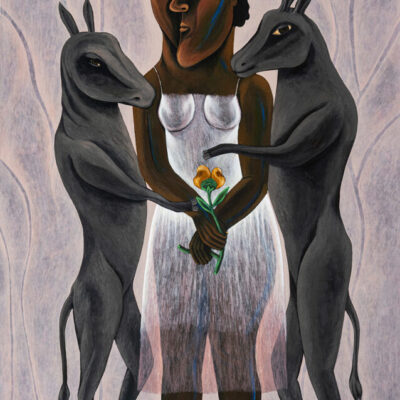
A Forced Relationship In the work where a woman appears trapped between two creatures resembling donkeys or deer, the concept of the exposed body becomes vividly embodied. There is no intimacy in this scene, but rather a form of disguised coercion. The rigid posture and the arms that grip rather than embrace reflect the desire of society, a society that not only deprives women of the right to refuse, but forces them to accept, and then holds them accountable for what was imposed upon them.
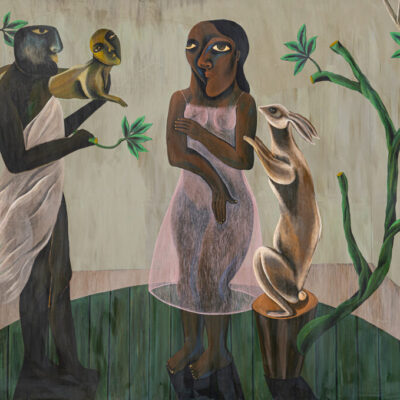
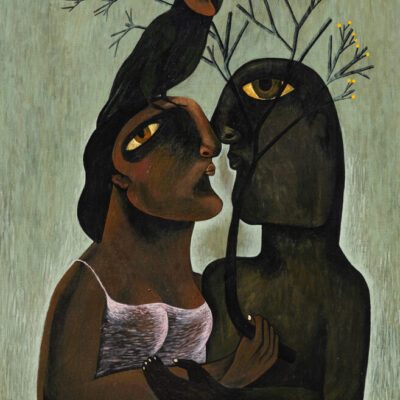
A Woman Present in a Primitive Scene This work transports us to a primordial setting in which a woman stands accompanied by a rabbit—a creature that, in Abdelrasoul’s visual universe, represents a neural extension and embodied anxiety: fear that has emerged from within and taken on a physical form. The animal elements in her paintings (such as rabbits or hybrid creatures) do not serve as rigid symbols, but rather as organic displacements. Here, an existential equality is achieved between beings: the woman does not coexist with the animal as an external other, but shares with it the same existential condition—tension and constant vigilance, a perpetual readiness to flee. The ground in this scene appears as a liquid memory that offers no stability, suspending existence between primitiveness and fragility, where neither movement guarantees survival nor stillness offers salvation.
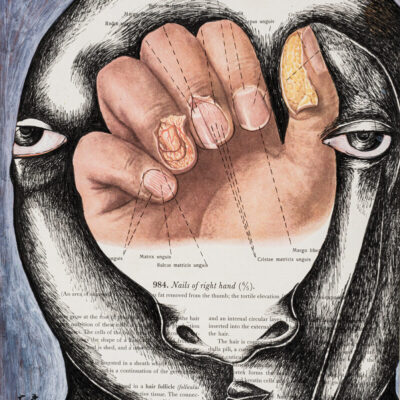
Violence as Atmosphere, Silence as System In Abdelrasoul’s work, violence shifts from being depicted as an incident to being presented as a permanent climate in which the body exists. This is evident in paintings that portray silence as a system. There is no visible blood or direct act of aggression; instead, we encounter an invisible structural violence that exhausts the body and transforms it from a space of expression into an tool of control. This is clearly manifested in hands covering mouths and in wide, alert eyes that reveal psychological vulnerability and the fear of disclosure.
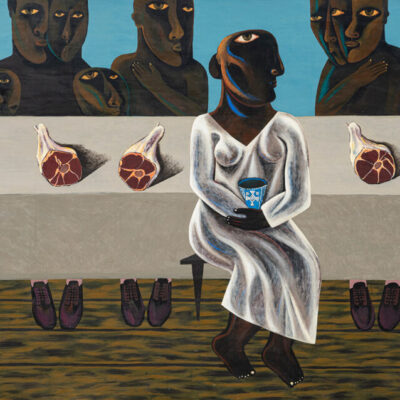
Female Slaughter Is Prohibited In the work depicting a table reminiscent of The Last Supper, rendered through a subversive vision, we see repeated faces and rigidly arranged pieces of flesh, reinforcing the notion of silence as a system.
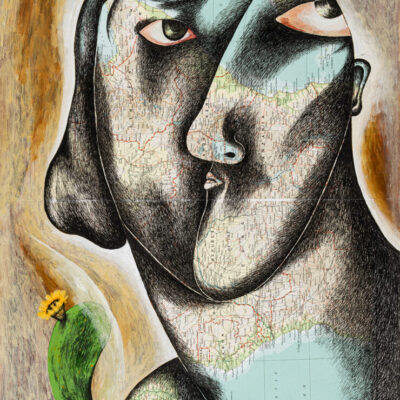
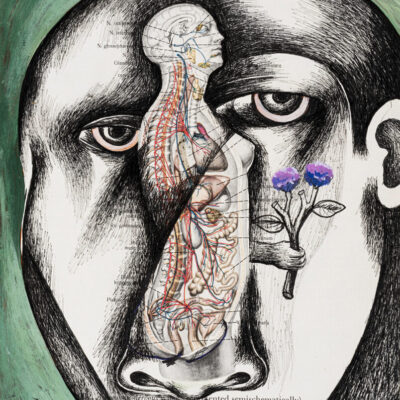
The Geography of Faces and Birth from Nature Abdelrasoul adopts the concept of existence prior to language, capturing the human condition before it becomes discourse or organized repression. The face in her works appears as a fractured geographic map, reflecting memory and socially inherited fears. In her project “Virtual Garden,” the body merges with botanical elements: flowers grow from mouths, and hearts transform into trees. Bodily representation is reconfigured as an equal interaction between human and nature.
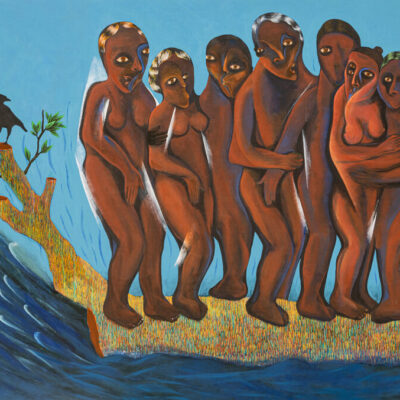
Between Survival and Drowning The Nile appears in Abdelrasoul’s work as a dual force. It is not merely a traditional symbol of fertility, but also a power that threatens to engulf existence, turning life into a daily exercise in survival. Her works do not offer ready-made answers; instead, they confront the viewer with an ethical question about the missing conditions of safety for women in society. This is an artistic moment in which the body no longer possesses the luxury of confrontation, but merely attempts to keep its head above water in an unstable world.
From the women pioneer painters to Souad If Inji Aflatoun used the body as a tool of political resistance, and if Gazbia Sirry charged it with collective tension and national dreams, then Souad Abdelrasoul belongs to a different moment altogether, a moment in which the body no longer has the luxury of confrontation, nor the illusion of symbolic victory. Her body does not resist, celebrate, or declare. It simply survives.
In comparison with pioneers such as Tahia Halim, Abdelrasoul shares an engagement with subjective concerns, yet moves beyond them toward a deeply personal confrontation with fear, as seen in “Virtual Garden,” where she poses questions such as “How does the rose fail to grow within us?” through layered visual metaphors.
The works of pioneering Egyptian women artists such as Inji Aflatoun, Gazbia Sirry, and Tahia Halim share many common features with those of the contemporary artist Souad Abdelrasoul, despite differences in generations and historical contexts. All of them place women and the human figure at the center of artistic expression, presenting women not merely as aesthetic subjects but as symbols carrying human, social, and psychological dimensions. They also share an expressive approach, a liberation from strict academic rules, the use of simplification and reduction of form in service of meaning, and the employment of symbolism to convey major themes such as freedom, identity, and belonging. While the pioneering artists were primarily concerned with social, national, and environmental realities, Souad Abdelrasoul extends this expressive line inward, exploring the human psyche through themes of isolation, contemplation, and self-searching. This continuity highlights the persistence of a feminist and humanistic vision in Egyptian art from the pioneering generation to contemporary practice, with changes in tools and approaches but with the essence of expression remaining sincere and intimate.
Souad Abdelrasoul’s practice does not demand a position from the viewer, nor does it offer an answer. Instead, it places the viewer within a difficult ethical question: what does it mean to allow women to appear without providing them with conditions of safety? In this sense, her work cannot be read as protest art, nor as conventional feminist art, but rather as a visual testimony to an existential condition that remains unresolved—suspended between survival and drowning.



Three Faces of Silence