El Semary’s new exhibition highlights pictorial surface as a composite entity Dr. Yasser Mongy
In his new exhibition Amshaj (Mixtures) Ayman El Semary does not merely offer another episode in a sequence of successive experiments, nor does he confine himself to a calculated technical refinement. Rather, through this project he undertakes a profound reassessment of the very concept of the pictorial surface, treating it as a composite, multilayered entity, laden with hybrids of memory, time, materiality, and symbol. From this perspective, the exhibition title Amshaj (Mixtures) functions as a precise structural description rather than a passing linguistic metaphor. It refers to a state of interaction and consonance among elements disparate in origin, yet capable—through a synthetic act—of generating a new unity that transcends mere aggregation or mechanical layering and approaches the concept of becoming.
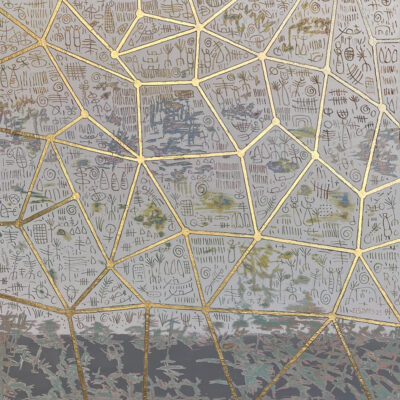
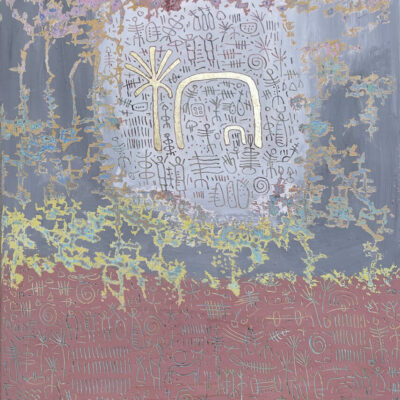
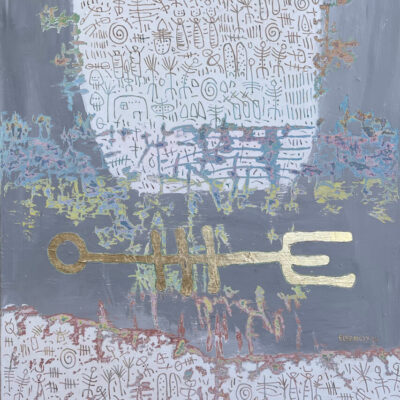
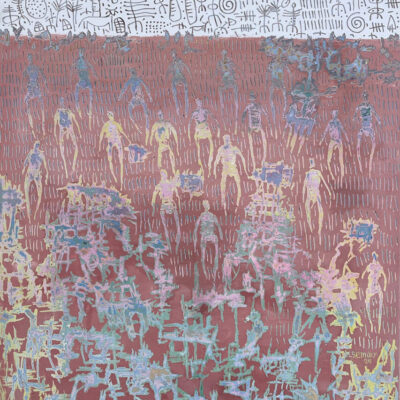
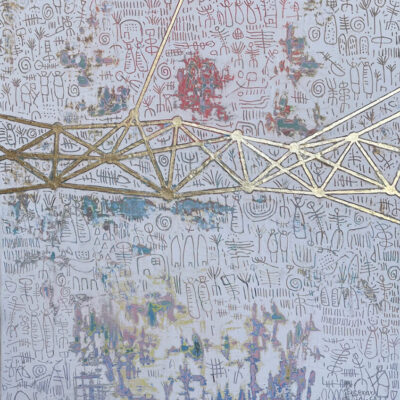
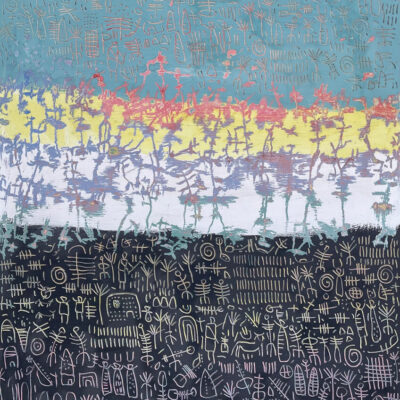
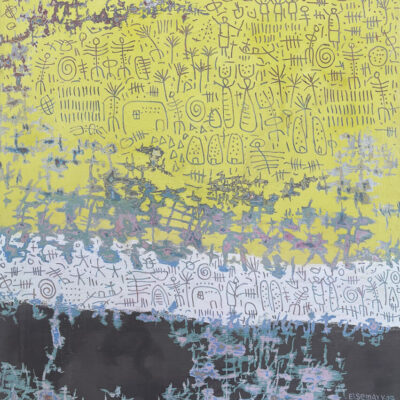
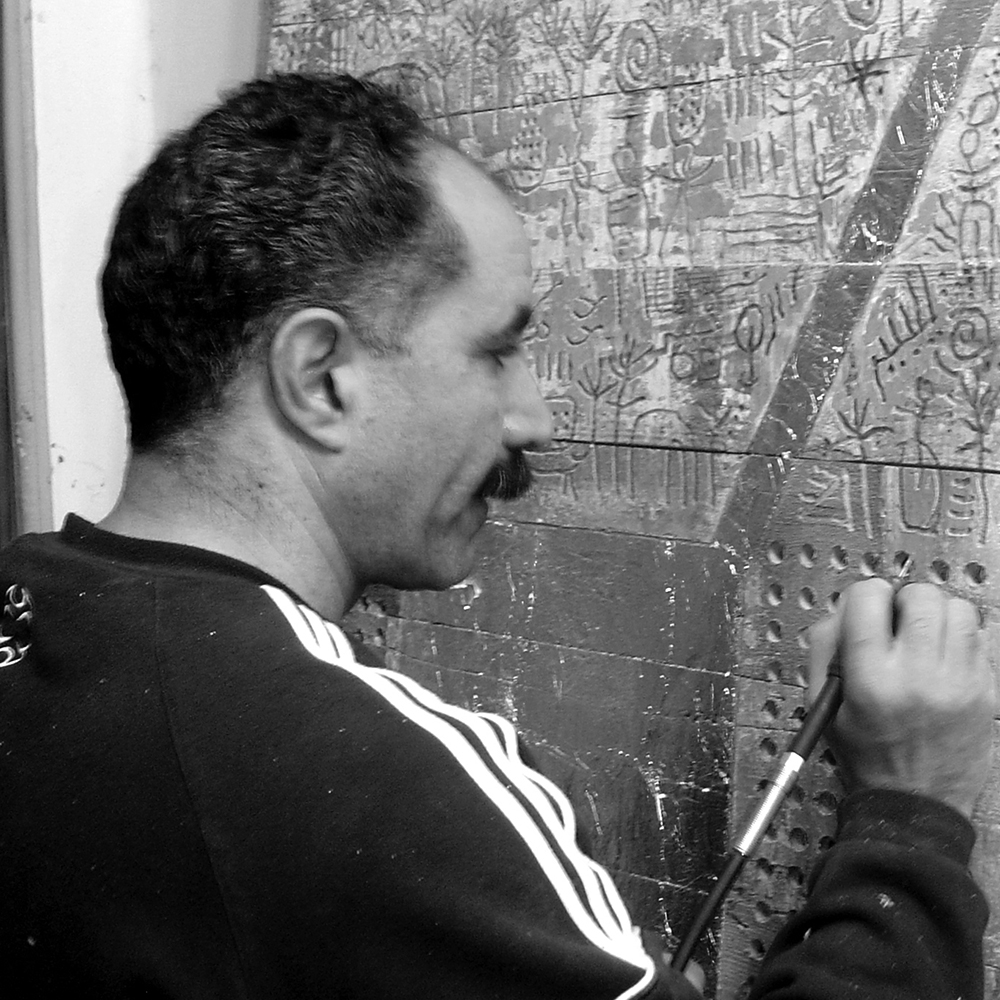
In this exhibition, El Semary relies on his signature technique, long the backbone of his visual discourse: constructing the surface through successive chromatic layers, applied one over another and left to enter a phase of hardening, before the artist initiates the counter-gesture of removal—scraping, sanding, incising, scratching, and abrading—according to the sgraffito technique.
Within El Semary’s practice, however, this method is not deployed as a decorative procedure or a display of formal virtuosity; it is invested as a cognitive act that reveals the surface’s history, reorders its strata, and transforms the painting into an archaeological site, in which traces of addition are read alongside traces of erasure.
In this sense, colour ceases to be a mere external layer and becomes instead a complex temporal record, where moments of presence and absence intersect, and where the marks of the hand merge with the imprint of time. This logic finds deep roots in El Semary’s early engagement with the aesthetics of walls of rural houses, lime washes, and the cracks, flakings, and fissures produced by annual process of repair—phenomena that carry within them the intertwined memory of people and place.
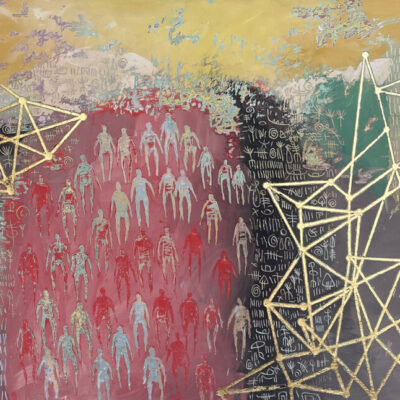
In Amshaj, the artist continues to develop the linear networks that appeared prominently in his earlier exhibition Khayma (Tent), incorporating gold leaf along certain trajectories. This use of gold is not ornamental nor a signifier of opulence; paradoxically, it functions as an extremely economical index, alluding to notions of dominance, containment, fleeting radiance, and the ambiguous relationship between the sacred and the everyday. These golden lines—sometimes resembling grid intersections or cellular structures—do not simply float atop the surface; they grasp it, imposing a hidden order reminiscent of systems of counting, delimitation, and organisation that have historically shaped the agricultural relationship to land.
Parallel to this, El Semary revisits his favoured script-like symbols, which evoke ancient inscriptions without belonging to a complete linguistic system. They are neither legible writing nor pure image, but an intermediary entity inhabiting the space between notation and drawing, between sign and meaning. In doing so, the artist reaffirms the pictorial root of writing—a root that reached its apex in ancient Egyptian civilisation, where image, script, and carving constituted unified tools of knowledge, accounting, ritual, and memory.
From a comparative standpoint, it is difficult to read this experience without invoking the broader context of modern and contemporary art history—not as a dominant reference, but as a landscape of intersections and dialogue. El Semary’s engagement with surface, with the imprint of time, and with dense materiality places him in direct proximity to the work of the seminal Iraqi artist Shakir Hassan Al-Said (1925–2004), who reconceptualised the wall as a living entity, charged with memory and subject to erosion, flaking, and obliteration. Yet, El Semary does not remain within a purely mystical or philosophical register; instead, he situates this engagement within an environmental and social context more closely tied to everyday life and to the Egyptian agricultural experience.
In the Western canon, these approaches resonate with the work of Antoni Tàpies (1923–2012), particularly in the notion of “representing hyle,” where the surface becomes the hub of resistance, abrasion, and deliberate distortion. The fundamental difference, however, lies in the referential framework: while Tàpies drew upon the memory of war, ruin, and existential absurdity, El Semary draws upon a memory of continuity, viewing the wall as an archive of life’s accumulation rather than a point of rupture. In this respect, his work bears a conceptual—though not purely technical—affinity with that of the pioneering Greek artist Vlassis Caniaris (1928–2011), notably his 1959 work Homage to the Walls of Athens 1941–….
One can also detect points of convergence with certain aspects of Anselm Kiefer (b. 1945), particularly in his use of layered earthen materials and in his understanding of the surface as a landscape of history and myth. Yet, while Kiefer engages with the weight of German memory and the questions of guilt and devastation, El Semary operates within a fluvial, agrarian memory—one that accumulates time without negating it, and embraces loss as part of life’s cyclical flow rather than as its negation. This approach also resonates with the practices of some contemporary sgraffito artists, who have used scratching and incising as a means of re-(writing) the surface. Yet, El Semary’s particularity lies in anchoring this technical procedure within a specific cultural context, one that neither detaches it from its roots nor dissolves it into a generalised, universal discourse.
Here, the concept of Amshaj extends beyond the mixing of materials or techniques to encompass the blending of reference frameworks themselves: the local with the global, the heritage-based and archaeological with the contemporary, the material with the symbolic, and the aesthetic-craft dimension with the conceptual. The works do not propose a single narrative nor wager on a definitive reading; instead, they keep the surface open, receptive to interpretation, and charged with multiple possibilities of meaning.
Accordingly, El Semary’s new exhibition may be regarded as a mature station in his artistic trajectory—a station that neither declares a divorce from what preceded it nor reproduces a familiar achievement, but rather deepens its questions and propels them further. Here, the pictorial surface evolves into a composite entity, weighted with time, open to history, and qualified to function as a site for creating the meaning rather than commercialising it.
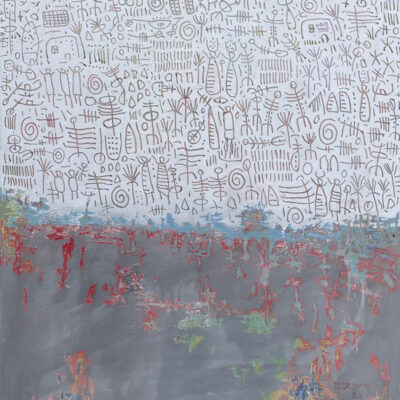


Mixtures II