There are moments when the mind rearranges chaos—when it sees the unseen, shapes coincidence into a face and creates form from emptiness. This is pareidolia: the psychological phenomenon that drives us to find faces in clouds, hidden features in the bark of a tree, or a crack in the wall.
But in Ayman Abu Khozaym’s work, this phenomenon goes beyond accidental perception. It becomes a deliberate aesthetic construction—an act in which the artist shapes wood, then invites the viewer’s gaze to complete the meaning.
In this exhibition, Abu Khozaym doesn’t present classic sculptures, nor does he aim for fully grown human features or recognizable figures. Instead, he sculpts smartly at the edge of perception—at that precise point where it’s unclear whether the eye is seeing something real or only imagining it. Here, wood is not merely a medium; it’s a living presence where images emerge on their own. Abu Khozaym’s wood becomes a surface that encourages engagement—not just from the viewers, but also from their imagination and distant memory.
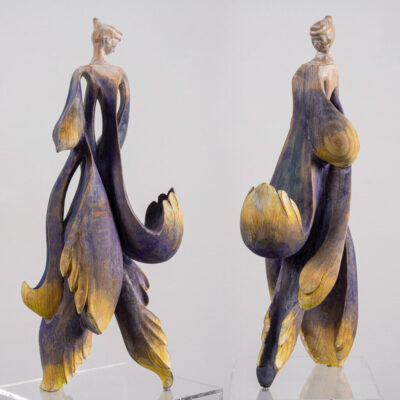
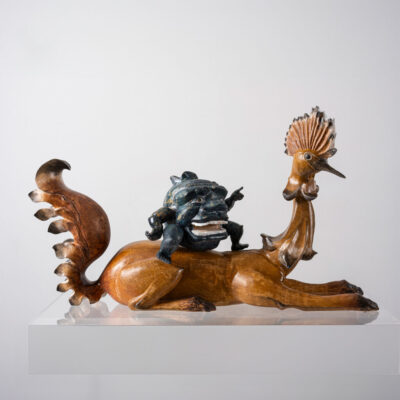
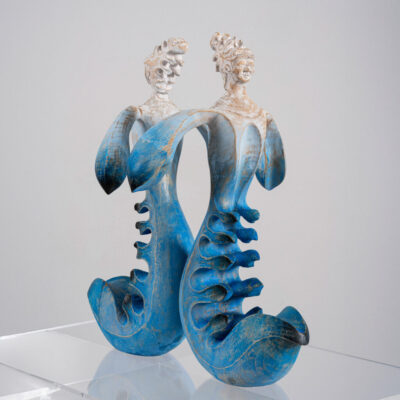
Some pieces appear like remnants of creatures—half-real, half-imagined. Others indicate latent emotional states, arising from hollows or protrusions that evoke eyes, lips, or bodiless heads. Each piece suggests the presence of a being, but never declares it outright. It’s as though the artist offers us a mask, not a face; a trace, not a body; and leaves the interpretation to our position before the image.
In this context, sculpture is not an act of representation, but of proposition. Abu Khozaym’s works don’t present form—they suggest it. They don’t provide answers, but open questions about what we see and what we think we see. The hollows, indentations, scratches, and delicate curves on the surface are not decorative, nor are they random. They are intentional cues that meaning does not present itself in full—it’s shaped through a silent collaboration between eye and material.
In this sense, Abu Khozaym engages in what might be called “sculpting perception”, where features emerge in the moment of contemplation, filtered through each viewer’s personal history, emotional state, and visual sensibility. Every piece in this exhibition is an open-ended proposal—a face, a creature, a feeling—impossible to fully grasp, yet equally hard to let go. These sculptures do not soothe—but unsettle. They don’t replicate what we know; they awaken what we’ve forgotten.
Seen from this perspective, Abu Khozaym’s experiment reflects a broader shift in contemporary sculpture; a move away from the academic model long tied to the duality of beauty and representation. Abu Khozaym’s works move toward more interpretive, marginal spaces. Contemporary sculptors are more interested in suggesting a new relationship between mass and void, and the role of sculpture as a perceptual medium—not just a physical form. Abu Khozaym’s work highlights this new thinking—not only as an aesthetic stance, but as an epistemological choice: to create works not to be explained, but experienced; not to reproduce the world, but to suggest its possibilities.
This orientation—with its affinity for ambiguity and openness—infuses sculpture with new experimental energy, reconnecting it to what is emotional and unconscious, in contrast to a world increasingly locked into fixed representations and literal images. The artist here doesn’t merely shift our focus; he invites us into a space where perception meets dream, sensation meets illusion, and abstraction meets familiarity—where the very act of seeing becomes the subject of sculpture.
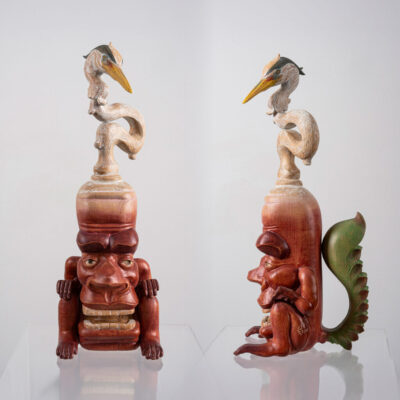
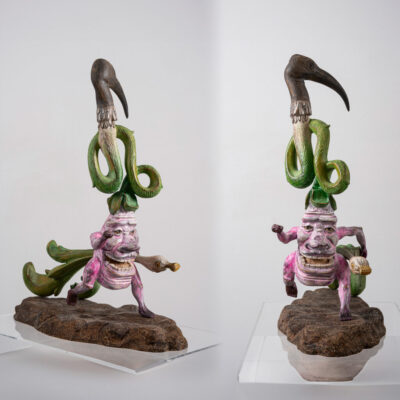
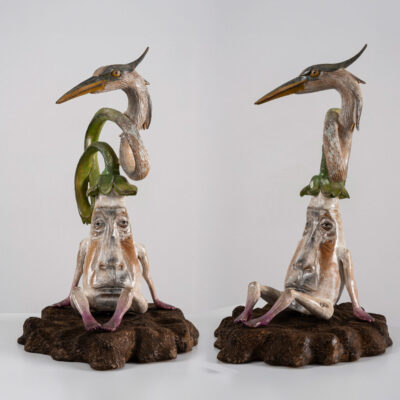
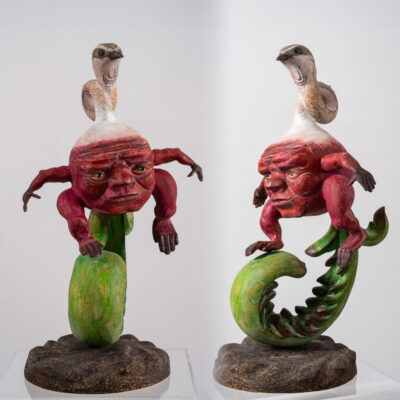
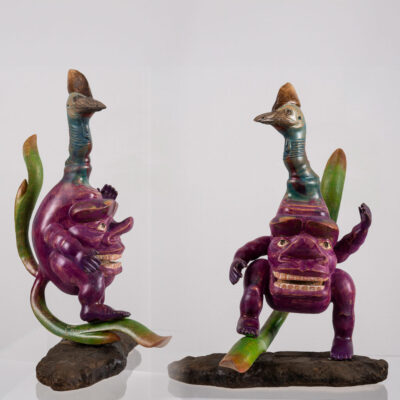
In Pareidolia exhibition, the experience reflects the harmonious unity between nature, humanity, and mythology. This stele offers a unique perspective on the aesthetic integration and cohesion among different forms of life. By depicting elements of vegetables or fruits in a lively manner—appearing as a complete creature with four legs, eyes, and a mouth, sometimes a human face with limbs and the head of a hoopoe bird—the sculptures embody this unique connection between the natural and the spiritual.
It is a contemporary story of the beautiful interaction between universes, where plants merge with aspects of humanity and myth in a scene that narrates the integration of life.
The work express the power of art in reshaping our daily reality and our understanding of the infinite bond between human and nature, evoking the philosophy of birds and animals in ancient Egyptian culture in a way that continues to tell a story of harmony and beauty.



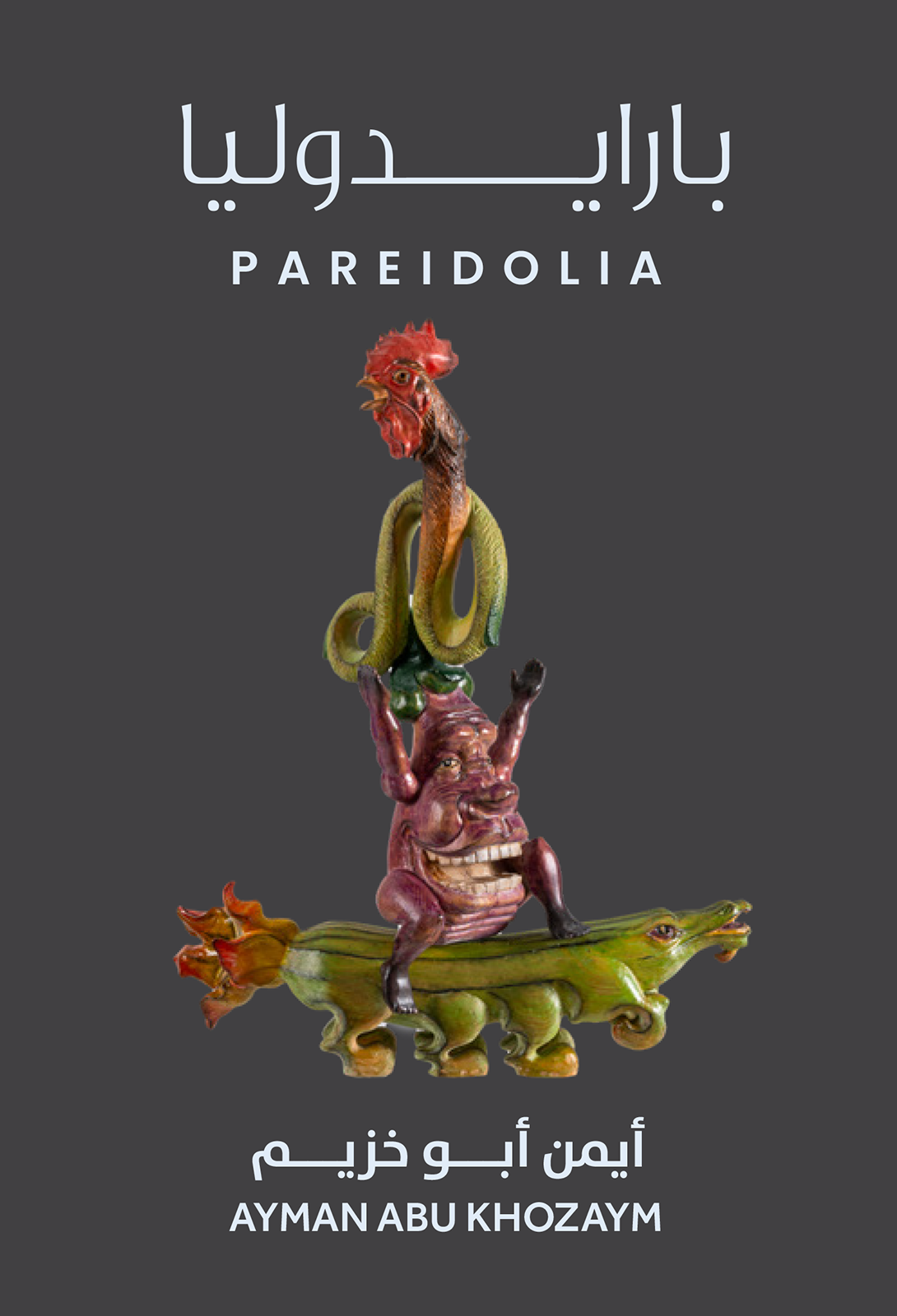
Black Roostplant